
The cheapest mission trip isn’t always the least expensive.
That’s an odd way to begin an article about mission trip costs.
After helping churches, schools, youth groups, families, and other teams plan mission trips since 2008, we’ve learned that the number printed next to “price per person” doesn’t always tell you what a trip is actually going to cost.
A $599 mission trip could be an incredible value.
But a $999 trip could actually save your group money.
And a trip advertised at a lower price could end up costing considerably more once transportation, meals, lodging, ministry materials, recreation, planning, and other expenses are added.
When you’re planning a mission trip, don’t begin with:
“Which trip has the lowest price?”
Ask:

Here’s how to figure it out.
1. Start With the Price Everyone Sees
Every organization structures pricing differently.
At Thirst Missions, for example, our 2027 Private Mission Trip options currently begin at:
- Appalachia — $599/person for 5 days/4 nights
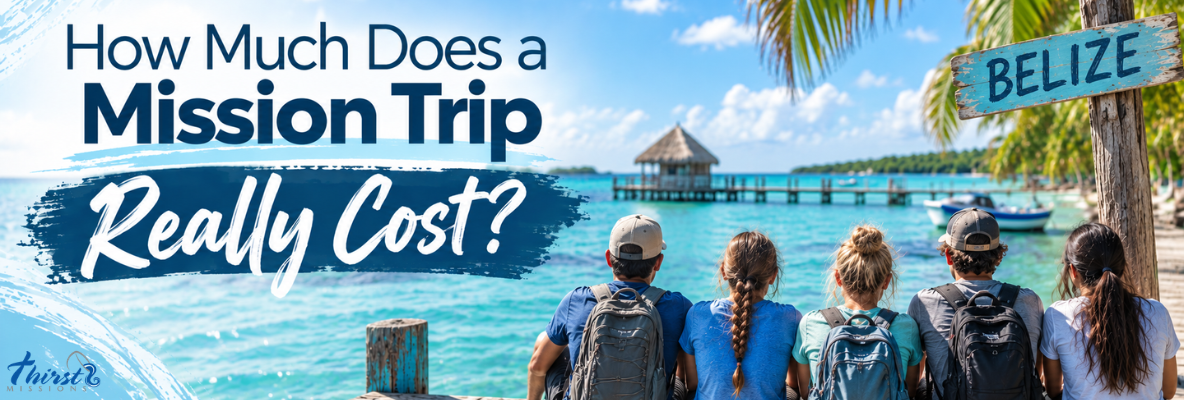
- Belize — $949/person for 6 days/5 nights
- Guatemala — $949/person for 6 days/5 nights
- Alaska — $999/person for 6 days/5 nights
- Puerto Rico — $999/person for 6 days/5 nights
Different lodging options are available at different price points.
The 2027 Youth Collective Mission Trips offer another model, with retreat-center lodging and set summer weeks in Nashville and New Orleans.
VIEW CURRENT 2027 PRICING & REGISTRATION
The advertised price is only the beginning of a good comparison.
2. Ask the Question That Matters More: What’s Included?
Imagine you’re comparing two mission trips.
Trip A: $750
Trip B: $950
- Trip A looks like the easy winner.
Now, the discovery that your group still needs to arrange some combination of:
- Lodging
- Meals
- On-the-ground transportation
- Ministry supplies
- Recreation
- Trip planning
- Local ministry contacts
- Staff leadership
- Devotional materials
- Participant resources
Now, that $200 difference can disappear quickly.
That’s why we encourage leaders to compare total trip cost, not simply the advertised price.
For most Thirst Missions Private Mission Trips, the base package includes lodging, meals and snacks, ministry and service-project materials, an experienced staff team, pre-trip consultation, a personal Mission Consultant, a customized hour-by-hour itinerary, participant materials, local church and ministry partnerships, evening worship and debriefs, recreation, a participant T-shirt, and an online trip portal.
On-the-ground transportation is also included in our Private Mission Trips in Alaska, Belize, Guatemala, and Puerto Rico. Groups traveling to Appalachia provide their own transportation.
SEE WHAT’S INCLUDED IN A THIRST MISSIONS TRIP
The point isn’t that every mission organization needs to include the same things.
It’s this:
Know what you are actually investing in before comparing prices.
3. Don’t Forget the Cost of Getting There
This can completely change the equation.
If you’re within driving distance of Appalachia, a domestic mission trip may allow you to dramatically reduce travel costs.
EXPLORE APPALACHIA MISSION TRIPS
If you’re flying, airfare needs to be added to your base package.
But even then, compare carefully.
Puerto Rico, for example, can give a group a culturally distinctive mission experience while remaining a U.S. destination.
EXPLORE PUERTO RICO MISSION TRIPS
Belize and Guatemala can provide an international mission experience and opportunities to serve alongside local churches and ministries.
EXPLORE BELIZE MISSION TRIPS or EXPLORE GUATEMALA MISSION TRIPS
And Alaska gives groups a remarkably different cultural, ministry, and geographic experience without leaving the United States.
EXPLORE ALASKA MISSION TRIPS
Don’t automatically assume international means “too expensive” or domestic means “cheap.”
Run the whole trip.
4. Put a Dollar Value on Your Leader’s Time
This is the expense almost nobody puts into the spreadsheet.
How many hours will your pastor, youth director, teacher, missions coordinator, or volunteer leader spend planning the trip?
Finding lodging.
Calling ministries.
Building schedules.
Finding projects.
Arranging meals.
Coordinating transportation.
Researching recreation.
Answering parent questions.
Creating packing lists.
Change the schedule when something falls through.
And then doing it all again when the group size changes.
That time matters.
One of the reasons Thirst Missions uses Mission Consultants and provides groups with a complete hour-by-hour itinerary is simple:
We want group leaders leading people—not spending the year becoming part-time travel agents.
Your leaders still lead.
They prepare their people spiritually. Build the team. Communicate with families. Raise support. Pray. Disciple. Encourage.
We handle much of the logistical infrastructure surrounding the trip.
That’s part of the value too.
5. Budget for the Things Nobody Remembers
Before announcing a mission trip price to your church or school, build a simple all-in participant budget.
Consider:
Mission trip package
- Transportation to the destination
- Airfare, if needed
- Baggage fees
- Travel-day meals
- Passport costs, if applicable
- Optional recreation
- Group-specific expenses
- Tips for staff leading your mission trip
- Emergency/contingency cushion
= Real estimated participant cost
Then communicate that number clearly.
Nobody enjoys hearing:
“The trip is $999!”
…followed by six months of:
“Oh, and we forgot one more thing.”
Clear pricing builds trust with parents and participants.
6. Don’t Let $100 Make a $1,500 Decision
This may be the most important financial advice in this article.
Imagine one trip ultimately costs your participant $1,450 and another costs $1,550.
Don’t automatically choose the first one because it’s $100 cheaper.
You’re already asking a family to make a significant investment.
Instead, ask what that additional $100 covers.
Better ministry partnerships?
Experienced staff?
More leader support?
Safer or more reliable transportation?
Better lodging?
Meals included?
Meaningful recreation?
Better planning?
More flexibility?
A stronger spiritual experience?
Less stress for your leaders?
The least expensive option may absolutely be the right option.
But price should help make the decision—not make the entire decision.
7. Affordable Doesn’t Have to Mean “Bare Bones”
This is something we think about a lot at Thirst Missions.
Different groups have different budgets.
That’s why our Private Mission Trip Collection offers different lodging choices and flexible dates, trip lengths, ministry focuses, and recreation options.
It’s also why we offer very different kinds of ministry locations.
A group might choose a 5-day Appalachia trip because they can drive and keep the overall cost especially affordable.
Another may choose Belize or Guatemala because an international experience and long-term local church relationships are important to their goals.
Another might choose Puerto Rico or Alaska because they want a dramatically different experience while remaining within the United States.
Youth ministries may prefer our Nashville or New Orleans Youth Collective Mission Trips, where multiple groups serve during the same week while Thirst Missions handles the schedule, ministry placements, lodging, meals, staffing, and program structure.
EXPLORE 2027 YOUTH COLLECTIVE TRIPS
There isn’t one right budget.
There’s a responsible budget for your group.

Enough to provide a safe, meaningful, well-planned experience.
Not so much that unnecessary expenses keep people from participating.
And transparent enough that families understand what they’re paying for.
Before choosing based on a price tag, compare:
Total cost. What’s included. Ministry quality. Local partnerships. Leadership. Safety. Flexibility. And the experience you’re actually creating.
Because you’re not simply purchasing six days somewhere else.
You’re creating an opportunity for people to serve, encounter another community, grow spiritually, strengthen relationships, and hopefully develop a greater understanding of what it means to live on mission long after they come home.
That’s the investment worth evaluating.

You don’t need to have everything figured out before talking with us.
Give us 15 minutes.
Tell us your approximate group size, where you’re coming from, possible dates, age group, ministry goals, and the budget you’re trying to hit.
We’ll help you think through which Thirst Missions options make the most sense.
[SCHEDULE A 15-MINUTE VIDEO OR PHONE CALL]
Or, if you’re ready to get your dates started: